Xiamen ZTC Tecnología Co., Ltd (Zentar) ZTC se ha centrado durante mucho tiempo en la optimización de ingeniería de las características de salida residual en transformadores de corriente de fase cero. Basándose tanto en análisis teóricos como en la experiencia de producción, ZTC desarrolló un enfoque técnico sistemático para reducir la tensión de salida residual a niveles extremadamente bajos.
¿Por qué existe salida residual en los transformadores de corriente de fase cero?
En teoría, cuando las corrientes vivas y neutras están equilibradas:
I_1 + I_2 = 0El flujo magnético dentro del ZCT debería cancelarse por completo, produciendo una salida secundaria nula.
Sin embargo, los transformadores del mundo real nunca son ideales.
Según el análisis técnico de ZTC, el voltaje de salida residual se origina principalmente a partir de cuatro factores fundamentales:
Defectos estructurales del núcleo magnético
Incluso pequeñas imperfecciones dentro del núcleo magnético pueden crear fugas de flujo:
Rebabas
brechas locales
Deformación mecánica
Permeabilidad magnética desigual
concentración de estrés
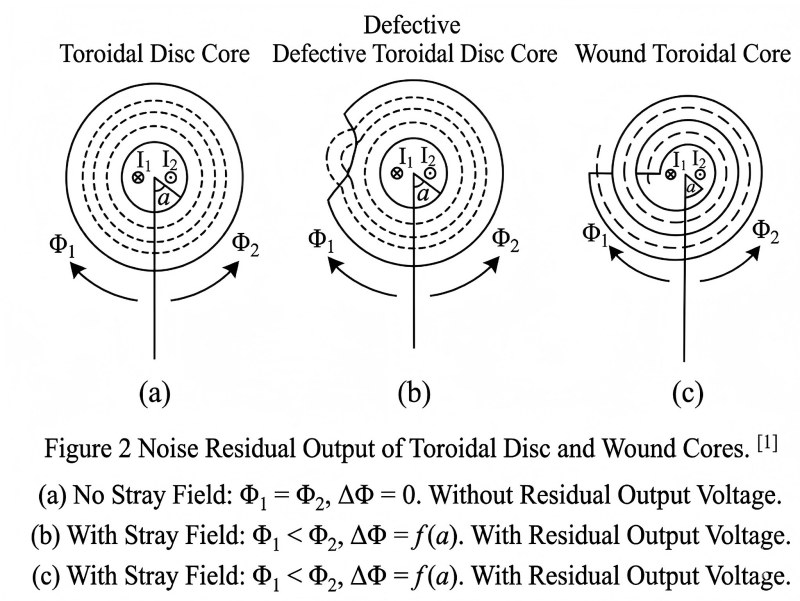
Estos defectos rompen la simetría magnética y generan campos magnéticos parásitos, que inducen una tensión de salida secundaria no deseada.
Muchos proveedores subestiman este problema.
Un núcleo barato aún puede "funcionar", pero en condiciones de protección contra fugas de alta sensibilidad, el desequilibrio se amplifica.
Esto es especialmente importante para:
Sistemas GFCI UL943
Detección de corriente residual tipo B
Protección contra fugas en cargadores de vehículos eléctricos
Aplicaciones con nivel de disparo de 4 a 6 mA
Solución técnica de ZTC: Núcleos toroidales laminados de alta integridad
La investigación de ZTC concluyó que los núcleos toroidales laminados con defectos estructurales mínimos ofrecen el mejor rendimiento en cuanto a baja emisión residual.
Para controlar la producción residual, ZTC se centra en:
Estampado de núcleos de precisión
Laminación sin rebabas
Ensamblaje con control de tensiones
Propiedades magnéticas uniformes
Materiales magnéticos blandos de baja direccionalidad
Esto es importante porque la salida residual es fundamentalmente un problema de simetría magnética.
La mayoría de las fábricas solo inspeccionan la relación de espiras y la inductancia.
ZTC añadido
Se centra exclusivamente en:
equilibrio de flujo,
simetría de la trayectoria magnética,
y la estabilidad de la salida residual en condiciones de carga dinámica.
Esa es la diferencia entre un proveedor de transformadores de corriente genéricos y un fabricante de componentes de protección centrado en la ingeniería.
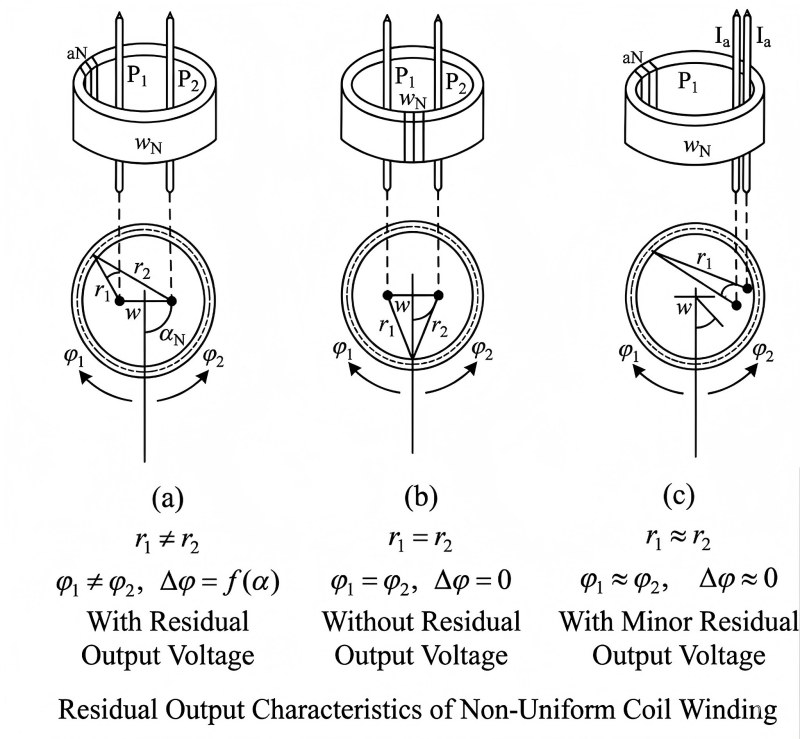
La simetría del bobinado secundario es igualmente crucial.
El artículo de ZTC también demuestra que una distribución desigual del devanado secundario crea un desequilibrio adicional en la salida.
Incluso con un buen núcleo magnético, una mala disposición del bobinado puede generar tensión residual.
El análisis muestra:
El espaciado desigual del bobinado aumenta el desequilibrio y el error.
La posición asimétrica de los cables crea un acoplamiento magnético desigual.
La salida residual varía con la posición angular.
Esta es una de las razones por las que algunos proveedores superan las pruebas de laboratorio, pero fallan en la verificación de la consistencia en la producción en masa.
Estrategia de control de fabricación de ZTC
Para minimizar el desequilibrio inducido por el bobinado, se aplica ZTC:
Distribución uniforme del bobinado
Geometría de disposición de cables controlada
Posicionamiento simétrico del conductor
Control estricto de la consistencia del proceso
Optimización de la precisión del bobinado automatizado
Esto mejora directamente:
consistencia del viaje,
estabilidad del lote,
y precisión en la detección de fugas de baja corriente.
La geometría del conductor primario a menudo se ignora, pero es importante.
Una de las partes más valiosas de la investigación de ZTC es el análisis de la asimetría del conductor primario.
Cuando los conductores de fase y neutro pasan a través de la ventana del transformador de corriente cero en posiciones asimétricas, se produce un desequilibrio magnético adicional.
Esto genera una salida residual incluso si:
El núcleo magnético es bueno,
y el devanado secundario es uniforme.
Muchos ingenieros pasan esto por alto durante la integración del sistema.
En aplicaciones reales como:
MCCB,
sistemas de carga de vehículos eléctricos,
paneles industriales,
y sistemas de protección de alta corriente,
El trazado físico de los conductores suele convertirse en la fuente oculta de inestabilidad.



 Soporta red IPv6
 español
 English
 français
 русский
 português
 العربية
 हिंदी
हिंदी